Daytime cleaning: better for employees, the environment, and the budget
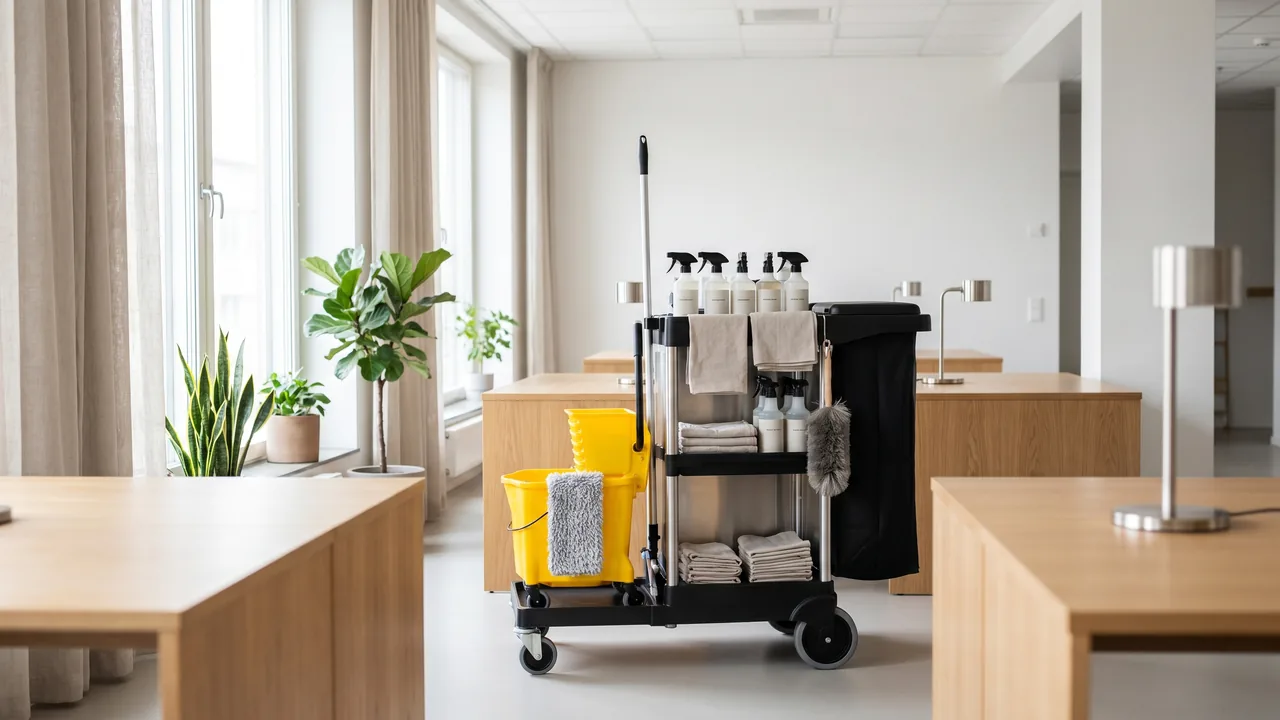
Daytime cleaning means your office is cleaned during working hours, while people are at work, not before everyone arrives or after everyone has gone home. You save the energy otherwise used to light and heat the building in the evening, you see that the cleaning is actually happening, and the cleaners avoid lonely night and morning shifts. Three benefits pointing in the same direction.
What is daytime cleaning?
The traditional model is simple: the cleaners arrive at 05:00, or after 17:00, and work in an empty building. Nobody sees them, and they see nobody.
Daytime cleaning turns this around. Cleaning is scheduled within regular working hours, typically between 08:00 and 16:00. The cleaner is on-site while you work, moves through the zones following an agreed route, and takes on the most visible tasks when it fits the flow of the office.
This is not a new invention. The model has been common in Denmark and Sweden for many years, and is finding its way into an increasing number of Norwegian commercial buildings. The driving force is a combination of electricity prices, environmental requirements, and a working environment that takes cleaners' conditions more seriously.
How does daytime cleaning save energy?
A building cleaned in the evening or at night must be kept running while it happens. Lights on all floors, ventilation on full, heating at comfortable levels. For an office with cleaning three to five evenings a week, we are talking about several extra operating hours that could otherwise have been turned off.
If you move the cleaning into working hours, it takes place during hours when the building is in full operation anyway. The marginal energy use for the cleaning itself is close to zero. You do not pay to light up an empty building.
How much this amounts to in NOK depends on the size of the building, the electricity contract, and how many evenings a week the cleaning would otherwise run. I will not guess at a number that looks precise, but the principle is solid: fewer operating hours mean lower energy bills and a lower climate footprint. For companies reporting on sustainability, this is a concrete reduction to point to. If you want to explore this path further, we have written down our thoughts on sustainable commercial cleaning.
Why does visible cleaning provide better perceived quality?
Cleaning that happens when nobody is watching easily becomes invisible in an unfortunate way: you only notice it when something is forgotten. A full waste paper basket on Monday morning, a coffee stain left behind.
When cleaning takes place during the day, the perception turns around. Employees see surfaces being wiped down, mirrors being polished, and common areas kept neat and orderly. Trust that the job is being done is built by actually seeing it get done.
It also provides a tighter feedback loop. If a meeting room needs an extra tidy-up before an important visitor arrives, it can be mentioned directly. The cleaner becomes a person you know, not an anonymous service appearing during the night. In my experience, this is the most underrated benefit.
To measure quality independently of what time of day the job is done, there is the standard NS-INSTA 800. It describes cleaning quality on a scale from 0 to 5, and is useful precisely because it evaluates the result, not the method or the time of day. If you want to use it as a buyer, we have a separate review of what INSTA 800 is.
Why is daytime cleaning better for cleaners?
This is the core of why I believe daytime cleaning is the right way forward. Cleaning is a profession that has long been pushed to the fringes of the working day. Early mornings, late evenings, long commutes to and from an empty building.
Daytime cleaning brings the work back to normal hours:
- Daylight and better health. Working in daylight rather than in an empty building at 05:00 is better for sleep, circadian rhythm, and well-being.
- An end to split shifts. Many cleaners currently have assignments spread across morning and evening. Consolidated daytime hours mean full, predictable working days.
- Social contact. The cleaner becomes part of the workplace community, not an invisible figure. This lifts both well-being and the status of the profession.
- A safer working situation. Being alone in a large, dark building at night carries an inherent risk. During the day, people are around.
This connects to how we at Vaskeladden think about the industry in general. Cleaning should be legal and proper, and that involves more than paying the correct wage. It is about the actual conditions people work under. For employees over 18 years of age in private cleaning companies, the universally applied minimum wage is 236.54 NOK/hour from 15 June 2025, with a separate night supplement of at least 29 NOK/hour. A serious firm must also be registered in the Norwegian Labour Inspection Authority's Renholdsregisteret. Since 1 July 2018, it has been illegal to purchase cleaning from a business that lacks legal status in the register. Read more about that in our guide to lovlig vaskehjelp og renholdsregisteret.
When you eliminate the night supplement by moving to daytime, you also free up funds that can go toward proper full-time positions rather than fragmented shifts. Lower operating costs and better working conditions point in the same direction for once.
What are the challenges, and how do you solve them?
Daytime cleaning is not effortless to introduce. The practical objections are real, but manageable with a little planning.
| Challenge | How to solve it |
|---|---|
| Vacuum cleaner noise disturbs meetings | Schedule vacuuming during breaks, lunch, or set low-traffic windows; use low-noise vacuum cleaners |
| The cleaner is in the way in open-plan offices | Zone-divided route, so one area is cleaned while people work in another |
| Sensitive rooms (HR, management, lab) | Agree on set times or dedicated access routines for these rooms |
| Employees are not used to seeing cleaning | Brief internal info prior to launch, so everyone knows what is coming and why |
| Restrooms and kitchens in use all day | More frequent, shorter rounds rather than one major session; temporary signage |
The key is a well-thought-out work schedule and a cleaner who works discreetly. Most companies that have made the transition find that the disruption they feared is barely noticeable in practice. If you are considering multiple models, it might also be worth looking into behovsstyrt renhold, where frequency is driven by actual use rather than a fixed calendar.
Does daytime cleaning suit all buildings?
Not necessarily. The model best suits offices, common areas, and buildings with steady daytime activity. If you have a production facility with heavy machinery, a building with restricted sensitive areas, or 24/7 operations, the solution must be adapted, and some tasks still belong outside core hours.
A practical way forward is a hybrid model: daily, visible cleaning during daytime, and periodic cleaning tasks such as machine floor scrubbing or deep clean scheduled for evenings or weekends. That way you get the energy savings and improved working conditions for most of the work, without forcing tasks into times where they do not fit.
If you are considering changing providers or models, it pays to ask the right questions early on. We have gathered them in our guide on how to choose a cleaning provider, along with an overview of what office cleaning costs as of 2026.
In summary
Daytime cleaning is one of those rare changes where considerations of budget, environment, and people point in the same direction. You cut energy use for a building that would otherwise stand lit and heated for empty premises. You get cleaning that you actually see being performed. And you provide cleaners with daylight, full working days, and a place in the community they have been excluded from for far too long.
It requires planning, and it does not suit every single building. But for most offices, the benefit outweighs the drawback, and the transition is easier than you think.