Winter cleaning: get rid of salt, slush, and winter dirt at home
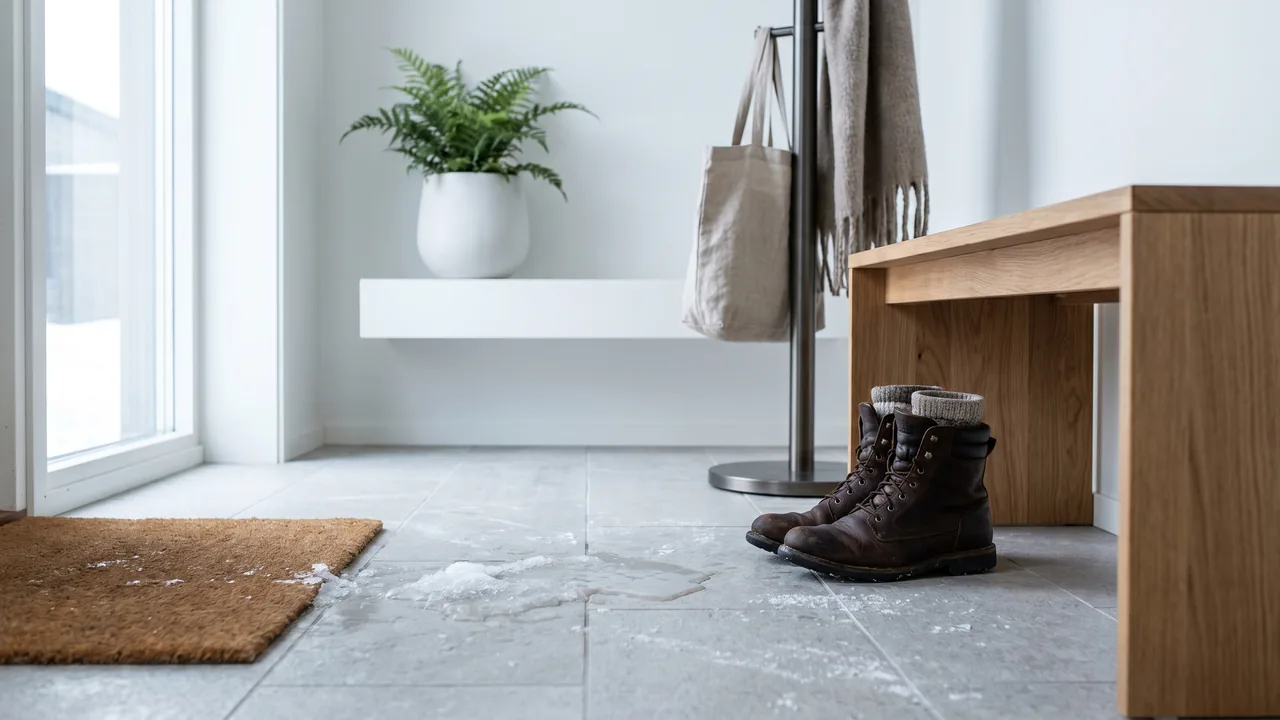
White salt stains are removed with a mild vinegar solution — one part white vinegar to ten parts lukewarm water — followed by a rinse with clean water. But do not use this on natural stone, marble, or untreated wood: the acid will etch the surface. Salt is alkaline, which is why a mild acid works. On vulnerable floors, simply use lukewarm water and a pH-neutral soap. The rest comes down to your routine at the door.
Why does winter salt leave white stains on the floor?
Road salt and grit travel in on the soles of your shoes. As the meltwater evaporates, the salt remains as a white, crystalline residue — what we know as salt stains on floors and footwear. Salt is hygroscopic, meaning it draws moisture to itself. That is why the spots feel clammy, and why they get worse the longer they are left. They bind new dirt and can eventually settle into porous surfaces.
The good news: salt is a base, and a mild acid dissolves it. The bad news: that exact acid is what ruins your stone floor. The entire secret to winter cleaning is knowing what floor you are standing on before pouring vinegar into the bucket.
How do I remove salt stains on the floor — without damaging the surface?
Start by sweeping or vacuuming up dry grit. Any sand left under the mop will scratch the floor. Then choose your method based on the floor type:
| Floor type | Method for salt stains | Never use |
|---|---|---|
| Vinyl, laminate, tiles (porcelain/ceramic) | 1 part white vinegar : 10 parts lukewarm water, rinse with clean water afterwards | Undiluted vinegar, steel wool |
| Varnished/sealed wood and parquet | Well-wrung mop, lukewarm water with a little pH-neutral soap | Vinegar, excessive water, steam |
| Oiled or untreated wood | Damp cloth, lukewarm water, dry immediately | Vinegar, citric acid, standing moisture |
| Natural stone – marble, granite, slate, limestone | Lukewarm water and a mild, pH-neutral stone soap | Vinegar, citric acid, any acid |
The vinegar solution is safe on most synthetic floors. Wipe in the same direction, and go over the area once more with clean water so you do not leave a film behind. For leather or suede footwear, dampen a cloth in the same mixture, wipe away the salt stains, and treat afterwards with leather conditioner.
The edge case: why acid and stone floors do not mix
This is the costliest mistake you can make. Marble, granite, slate, and limestone contain calcium carbonate. Acid — whether white vinegar, citric acid, or a commercial limescale remover — reacts with the calcium and etches the surface. The result is dull, rough spots that cannot be washed or polished away; they must be ground down by a professional. Winter salt itself does not damage the stone. So on a natural stone floor, the issue is purely cosmetic, and lukewarm water with a pH-neutral stone soap resolves it completely. Always test a vinegar solution in an inconspicuous spot first if you are unsure of the material — under a plinth or behind a door.
Safety: what do I need to be careful with regarding cleaning agents?
One rule is absolute:
- Never mix bleach with anything other than water. Bleach + vinegar produces chlorine gas. Bleach + ammonia yields chloramine. Both are toxic gases. Either way, you do not need bleach for winter cleaning.
- Keep white vinegar away from natural stone, marble, and untreated wood.
- Ventilate well and wear gloves when working with acid over extended periods.
- Keep agents in their original bottles so no one mixes anything by accident.
How do I set up an entryway routine that stops dirt?
Most of the battle is won at the door. If you stop salt and slush there, you avoid hunting for stains throughout your home. A simple checklist:
- Two mats, not one. A coarse scraper mat outside, and an absorbent mat inside. The outer one catches sand and snow; the inner one catches the meltwater. Studies on entry zones using Norwegian figures are scarce, so I stick to the practical side: the longer the barrier zone, the less dirt travels inside.
- Shoe rack with a drip tray. Meltwater from shoe soles should be collected, not run out onto the floor and evaporate into salt stains.
- Wipe up slush the same day. Meltwater left to sit turns into stains. Keep a microfiber cloth or a small mop handy in the entryway.
- Shake out the mats outside twice a week, more often during cold spells. A saturated mat stops absorbing.
- Mop the entryway floor two to three times a week during the worst months, using the right method for your floor type.
Wash the mats yourself or replace them with clean ones. Rubber-backed mats can be hosed down with lukewarm water; textile mats should be shaken and aired. When mats dry slowly because of cold weather, hanging them up helps rather than laying them flat.
What about dirt from cars, garages, and bicycles?
A winter car brings in its own dose of salt, sand, and oily road grime. In the garage or storage room, the floor is usually concrete or epoxy, which tolerates heavier treatment than a living room floor.
- Concrete and epoxy: hose down or mop with lukewarm water and an alkaline degreaser for oil stains. Salt stains on concrete can be wiped off with water; concrete tolerates a mild vinegar solution, but check first whether the floor is sealed with a calcium-based product.
- Rubber car mats: take them out, hose off sand and salt, and let them dry completely before putting them back. Salt left in the mats will rust the mounting points underneath.
- Bicycles and strollers: wipe down frames and wheels before bringing them inside. Salt accelerates rust on metal.
Keep this dirt in the garage and storage room — do not drag it further into your home on the same shoes.
How do I protect woodwork throughout the winter?
Wood is the most vulnerable material in winter, because the combination of salt and standing moisture lifts the surface finish. For parquet, wooden floors, and woodwork near the entrance:
- Use a well-wrung mop — damp, never wet. Wood and water do not mix.
- Choose a pH-neutral soap formulated for wooden floors. Skip vinegar and citric acid completely.
- Wipe up meltwater and snow lumps right away. A puddle by the door will soak into the joints.
- Place an absorbent mat in front of the front door so soles deposit their moisture there.
- Oiled floors may need a fresh coat of floor oil in high-traffic areas after a harsh winter — follow the manufacturer's instructions.
Steam cleaning might be tempting when everything is sticky, but keep it away from wood and laminate: hot steam forces moisture down into the joints and can cause the edges to swell.
When does it pay to outsource winter cleaning?
If you can manage the daily wiping, you can handle most of it yourself. But if you have a large entryway, natural stone you are afraid of damaging, or simply lack time during a busy winter, regular cleaning assistance is a practical alternative. Market rates for private home cleaning as of 2026 typically range between 350–550 NOK per hour including VAT, depending on the city and the assignment. For employees over 18 in private cleaning companies, the universally applied minimum wage is 236.54 NOK per hour as of 15 June 2025. A quote far below market rates should be scrutinized, though price alone does not reveal what someone is paid or whether the work is legal.
Remember also that since 1 July 2018, it has been illegal — including for private individuals — to purchase cleaning services from a company lacking legal status in the Norwegian Labour Inspection Authority's Renholdsregisteret, and doing so is punishable by law. Check that their status is "Godkjent", "Søknad under behandling", or "HMS-kortbestilling under behandling" before ordering. If you want to know more about the rules, read lovlig vaskehjelp og renholdsregisteret. If you are selecting a provider, we have a dedicated guide on hvordan du velger renholdsleverandør.
In summary
Winter dirt comes down to two things: stop it at the door, and remove it using the right method for your floor type. Salt stains dissolve in a mild vinegar solution — but never on natural stone or untreated wood, where lukewarm water and a pH-neutral soap are the answer. Never mix bleach with anything other than water. If you set up two mats, a drip tray, and a daily wipe-down routine, you will avoid most of the work. If you wonder how often the rest of your home should be cleaned throughout the year, take a look at hvor ofte du bør vaske hjemmet.