Cleaning equipment the pros use – buying guide 2026
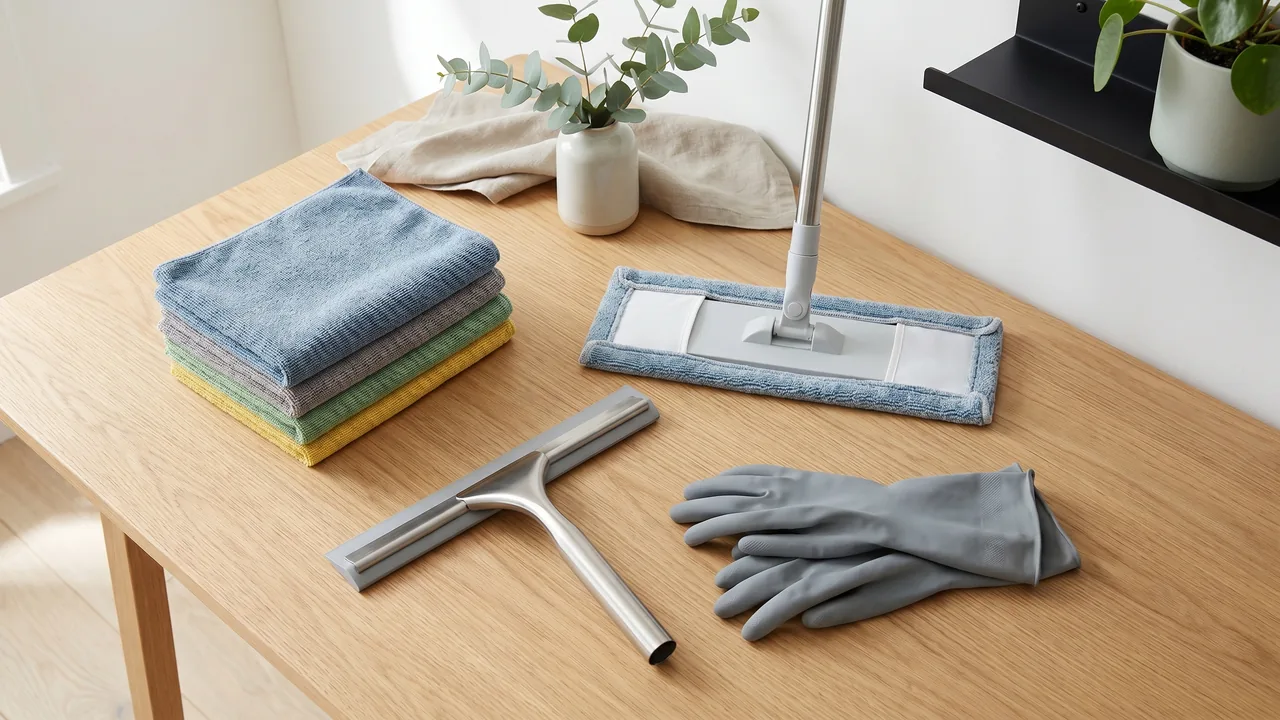
If you want to clean faster and better at home, you need surprisingly little: a set of microfiber cloths in four colors, a flat mop with replaceable pads, and a window squeegee cover roughly 80 percent of the job. What professionals do differently isn't using more expensive equipment, but having a system—color coding and zones that prevent dirt from being moved from one room to another.
In this guide, we walk through what you should actually buy in 2026, what you can safely skip, and how to set up a simple zone system at home. We won't mention any brands—good equipment exists in all price ranges, and the most important thing is how you use it.
What is color coding, and why do pros use it?
Color coding means that each cloth and mop color is assigned to a specific zone. The idea is simple: a cloth that has been used on the toilet should never end up on the kitchen counter. By keeping the colors separate, you avoid transferring bacteria between areas.
The most common system in the industry looks like this:
| Color | Zone | Typical surfaces |
|---|---|---|
| Red | Toilet and urinal | Toilet bowl, seat, floor around toilet |
| Yellow | Rest of the bathroom | Sink, shower, mirror, tiles |
| Green | Kitchen | Counter, sink, refrigerator exterior |
| Blue | General surfaces | Tables, window sills, doors, furniture |
You don't need a professional laundry setup to use this. Buy microfiber cloths in four colors, hang them on separate hooks, and treat the system as fixed. After a couple of weeks, it becomes second nature.
Professional cleaners also use zones in another sense: they work systematically through a room—from top to bottom, from the furthest point outward—so they never drag dirt over a surface they've just wiped. The same logic works at home.
Which microfiber cloths should you choose?
Microfiber is the single item that makes the biggest difference. A tightly woven microfiber cloth captures dust, grease, and bacteria mechanically, often without chemicals at all—with just water, it removes most everyday dirt.
Three things separate a good cloth from a bad one:
- Density. Heavier cloths (measured in grams per square meter) trap more dirt and last longer. Feel the material: a dense cloth feels plush, not thin and slick.
- Wash without fabric softener. Fabric softener leaves a film on the fibers that ruins absorbency. Wash the cloths at 60 degrees Celsius without fabric softener.
- Right type for the right surface. A smooth, thin cloth is best for glass and mirrors. A waffle or terry cloth structure works better on rougher surfaces.
A starter set of eight to twelve cloths, divided into four colors, will last a long time. Switch to a clean cloth when the one you are using becomes saturated—a dirty cloth just smears things around.
Do you need a flat mop, or is a regular mop fine?
For hard floors, a flat mop with replaceable microfiber pads is the best upgrade for your money. It sits flat against the floor, picks up more dirt per stroke, and lets you switch to a clean pad between rooms. A traditional cotton string mop holds a lot of water, but quickly turns gray and spreads dirt instead of removing it.
Here is how to wash floors efficiently with a flat mop:
- Dry mop or vacuum first, so you don't smear around grit and hair.
- Lightly dampen the pad—it should be damp, not dripping wet.
- Work in overlapping strokes, and swap the pad when it becomes visibly dirty.
- Have several clean pads ready so you don't have to wash the mop in the middle of the job.
For wood and laminate floors: use minimal water and a mild cleaner. Standing water is the most common cause of streaks and swollen joints on laminate.
Soft soap or all-purpose cleaner—what should you have?
Both, but for different tasks. Soft liquid soap is mild, alkaline, and gentle—great for painted surfaces, untreated and varnished wood, and general floor washing. It lathers little and leaves little residue behind, but it isn't strong enough against heavy grease.
All-purpose cleaners are more effective against grease and stubborn stains on counters, tiles, and enameled surfaces. For the kitchen, where most tasks involve grease, an all-purpose cleaner is usually the most effective choice.
A few simple rules:
- Follow the dosage instructions. Using more cleaner doesn't result in cleaner surfaces, only sticky streaks you have to wipe away again.
- Never mix different products in the hope of getting a stronger solution.
- Rinse surfaces you eat from afterwards.
Safety: never mix chemicals
This is non-negotiable. Never mix bleach with anything other than water. Bleach and vinegar create chlorine gas; bleach and ammonia or salmiak create chloramine—both are toxic and can be life-threatening in an enclosed bathroom. If you use a bleach-based product, rinse thoroughly and ventilate before using anything else.
And another one: acid dissolves limescale, but vinegar, citric acid, and descalers corrode natural stone such as marble, granite, and slate, and can damage untreated wood and certain enameled surfaces. On tiles and glass, acid is safe; on natural stone, use a pH-neutral cleaner. Always test on a hidden area first. If you want to go deeper on limescale, we have a dedicated guide on å fjerne kalk på bad og dusj.
How do you get streak-free windows?
A window squeegee (scrapper with a rubber blade) is the simplest trick for streak-free windows. Wash the pane with lukewarm water and a drop of dish soap, pull the squeegee down from top to bottom in overlapping strokes, and wipe the blade with a cloth between each stroke. Finally, wipe the edges dry with a smooth microfiber cloth.
Choose a squeegee with a replaceable rubber blade—the blade is what wears out, and a stiff or nicked blade will create streaks regardless of your technique. Ideally, wash windows on a cloudy day; strong sunlight dries the window before you have time to pull off the water. Read more about technique in our guide on vinduer uten striper.
What do you actually not need?
Much of what is sold as "smart" cleaning solves problems you do not have. Here is what you can safely skip:
- Disposable wipes and wet wipes in large quantities. Expensive over time and worse than a microfiber cloth you wash and reuse.
- A separate special cleaner for every room. All-purpose cleaner and soft yellow soap cover most needs. Specialized products are for specialized problems.
- Antibacterial sprays for daily surface cleaning. For an ordinary home, microfiber and water are enough. Disinfection is for specific situations, not daily routines.
- Steam mops as a replacement for everything. They have their place, but can damage delicate floors like untreated wood and certain laminates. Not a universal solution.
- Scent boosters and fresheners. They mask odors instead of removing the cause.
Budget or professional – what is the difference?
The difference between an affordable and an expensive set is mostly about durability and comfort, not how clean things get. A budget set gets the job done; a professional set lasts longer and is easier to work with over time.
| Equipment | Budget | Professional | Worth the upgrade? |
|---|---|---|---|
| Microfiber cloths | Thin, mixed quality | Dense, color-coded, lasts many washes | Yes – lasts much longer |
| Flat mop | Fixed pad, lightweight frame | Replaceable pads, sturdy handle | Yes – the pads are key |
| Window squeegee | Fixed blade | Replaceable rubber blade | Yes – the blade wears out |
| Bucket/system | Simple bucket | Dual-chamber (clean/dirty water) | Only for large surfaces |
| Cleaner | All-purpose cleaner + soft yellow soap | Same | No – an expensive brand does not get things cleaner |
The point: spend money on equipment that wears out (cloths, mop pads, squeegee blades) and save on cleaning agents. A good basic set does not need to cost much, and you can expand it as you see what you actually use. If you want to see what a greener shopping list looks like, we have a guide to miljøvennlig rengjøring hjemme.
How to build your basic set
If you are starting from scratch, this is a good order:
- Microfiber cloths in four colors (red, yellow, green, blue) – at least two of each.
- Flat mop with frame and three to four extra pads.
- Window squeegee with replaceable blade.
- All-purpose cleaner and soft yellow soap.
- A soft dish brush and a small scrubbing brush for grout.
- Gloves – cheap, but saves your hands.
That is the entire basic set. Add specialized equipment only when a concrete task requires it, not just in case.
If you do not want to do it yourself, a cleaner can take the job using their own equipment and system. Always check that the company has legal status in the Norwegian Labour Inspection Authority's Renholdsregisteret before booking – it has been illegal and punishable, including for private individuals, to buy cleaning services from a business that lacks such status since 1 July 2018. If you wonder how often the home actually needs to be cleaned, we have put together an overview of hvor ofte du bør vaske hjemmet.